Where Does the Water for Angel Falls Come From? The Geographical Truth Behind the World's Highest Waterfall
Venezuela Voyages
Venezuela Voyages
Discover the fascinating geographical origin of Angel Falls. We analyze how the Auyantepui acts as a natural sponge feeding the world's highest waterfall and what you need to know based on your travel season to Canaima.
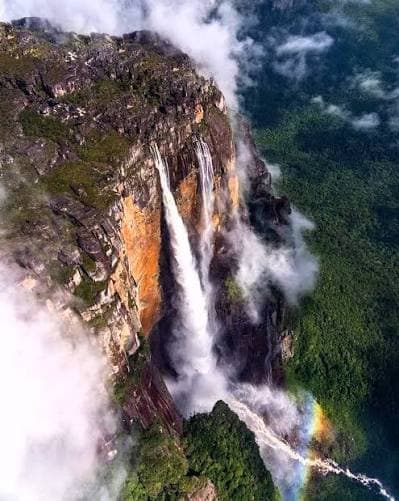
When we think of the planet's great waterfalls—like Niagara or Iguazu—we imagine monstrous volumes of water fed by continental rivers crossing thousands of miles. Because of this, one of the most frequent questions among travelers and the curious is: where exactly does the water that plunges down Angel Falls, the world's highest uninterrupted waterfall at 979 meters, actually come from?
The answer breaks away from traditional geographical intuition. There is no giant river feeding the summit from another region; the secret lies in the very architecture of Venezuela's Gran Sabana.
The Auyantepui: A Giant Sponge in the Clouds
To understand the origin of Angel Falls' water, one must first understand what a tepui is. These table-top mountains are the remnants of an ancient sandstone plateau that covered the region millions of years ago. The Auyantepui, the tabular mountain from which the waterfall drops, spans approximately 700 square kilometers on its summit.
Far from being a smooth, barren rock surface, the top of the Auyantepui is a labyrinth of deep fissures, canyons, sinkholes, and endemic vegetation. Practically speaking, it acts as a giant natural sponge:
Extreme Catchment: The summit is exposed to moisture-laden winds coming from the Atlantic Ocean and the Amazon rainforest.
Constant Precipitation: It rains nearly year-round, accumulating millions of liters of water on its upper plateau.
Underground Storage: Rainwater is absorbed by the vegetative layer and filtered through sandstone fractures, creating a network of internal streams and aquifers that feed the headwaters of local rivers.
The Birth of the Kerep River
All that water accumulated on top of the Auyantepui does not remain stagnant. It naturally converges into a series of small streams that join in the northwestern part of the plateau to form the Kerep River (also known as the Kerepakupai River).
It is this river that, after crossing the flat surface of the summit, suddenly reaches the edge of the abyss at a spot known as the Devil’s Gorge, plunging into the void with a free fall of 807 meters (and a total drop of 979 meters including the lower cascades). The impact atomizes a large part of the flow before it hits the ground, generating a dense mist that nourishes the surrounding jungle and feeds into the Churun River.
The Impact of the Seasons: Myth vs. Reality for the Traveler
A common mistake among tourists is assuming that Angel Falls looks identical 365 days a year. Because it depends almost entirely on direct rainfall over the Auyantepui rather than glacial melts, its flow is highly seasonal:
The Rainy Season (May to November): The summit receives continuous torrential downpours. Angel Falls shows its most majestic face, with an imposing, roaring flow visible from afar. However, the weather can complicate river navigation and aerial visibility.
The Dry Season (December to April): Rainfall drops drastically. During the driest months (February and March), the Kerep River's flow decreases so much that the water often evaporates into mist before hitting the base, turning into a thin, delicate stream.
A Strategy for Travel Planning: Radical Honesty in Business
Understanding this hydrological cycle is not just trivia for a geography class; it carries immense strategic business value for any travel proposal.
Many tour operators sell the illusion that Angel Falls looks identical year-round. As an authentic brand strategy devoid of false logistical promises, it is vital to inform the traveler about this reality:
If you want to see a roaring wall of water, you must accept the climatic risks of the rainy season.
If you prefer safer river navigation through Canaima and trekking without relentless mud, you will enjoy breathtaking landscapes, even if the waterfall is thinner.
Honesty about the nature of a destination is what builds true authority on the web and turns a curious reader into a loyal customer.
Understanding the true dynamics of the Auyantepui is vital for choosing the perfect moment for your journey. If you want to experience the complete adventure—combining the river majesty of the jungle with the total disconnection of the Caribbean Sea—check out the details of our Canaima & Los Roques Package.
Ready to travel?
Let us help you plan your next adventure through Venezuela.